
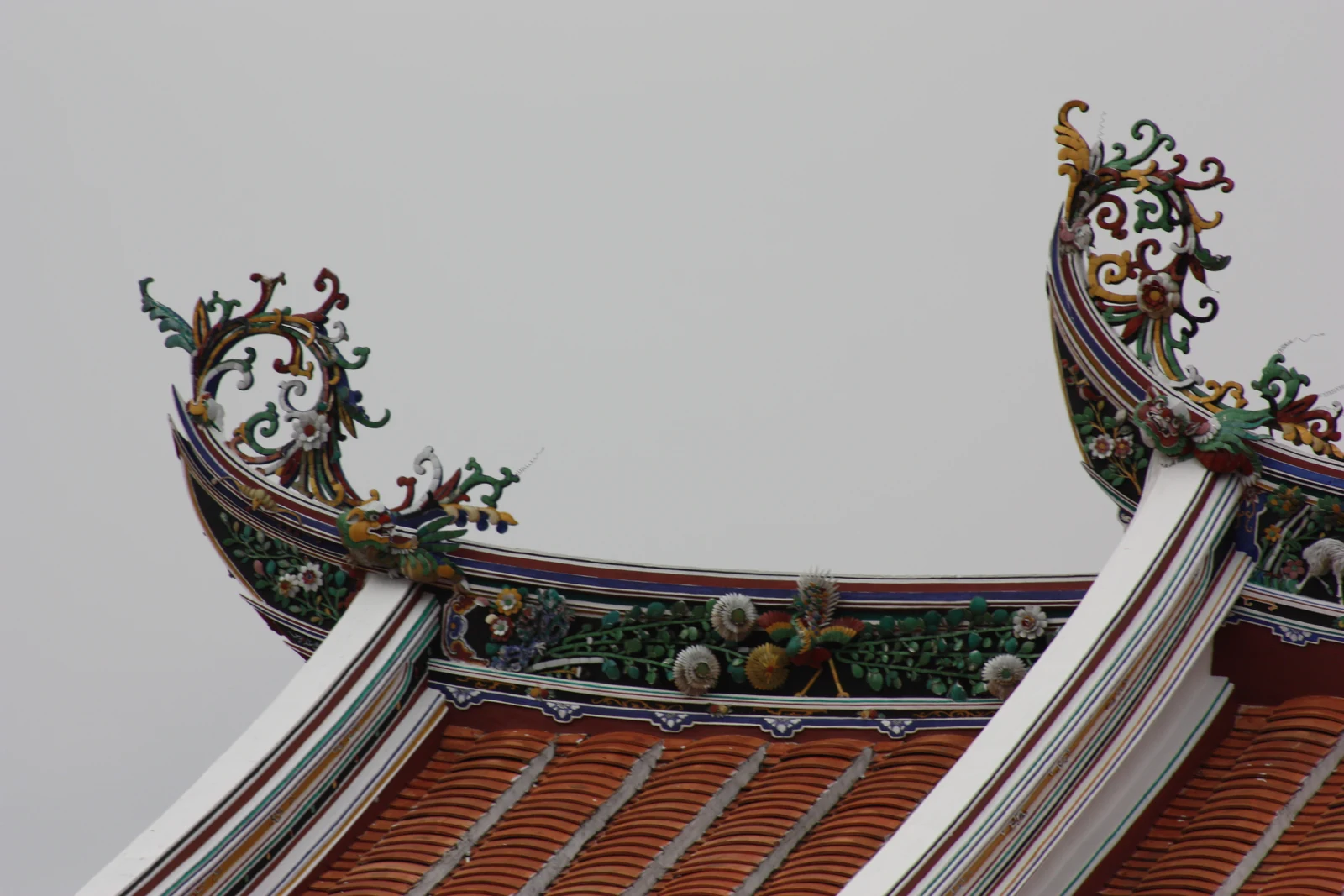
Roof detail photographed by Irwan Shah Bin Abdullah / eHalal.io on 17 July 2009. Historical architectural reference, not a report of today's condition. Resized and converted to WebP; responsive crops. Image adaptation: CC BY-SA 4.0.
First, read the roof as a silhouette
Before trying to name any ornament, trace the roof's outline from one end to the other. Where does it rise, where does it settle, and where do smaller shapes interrupt it? The historical photograph above makes that exercise easy: curved ends, coloured edges and denser clusters of decoration pull the eye in different directions.
Try taking one wide photograph and one detail photograph from a permitted visitor area. Afterwards, ask which detail helped you recognise the larger building. This is an observation game, not an official guided activity. A beautiful roof does not need an invented legend attached to every motif.
When asking for a quote
Send hotel, passengers, luggage and return timing together
Complete details make it easier to check vehicle fit, rest stops and timing without unnecessary back-and-forth.
Then look for the building beneath the decoration
The temple's architecture notes describe craft traditions associated with southern Fujian and Guangdong, a three-bay arrangement, and timber columns resting on stone bases. Those are useful starting points for looking past the surface. Notice the change from stone to wood, and how upright supports relate to the shelter overhead.
Choose one column or one visible junction rather than trying to inspect everything. What can you see clearly, and what is hidden? Leave technical interpretations to the temple's material or a knowledgeable guide. Visitor curiosity does not justify stepping over a barrier, touching a surface or entering a restricted area.
Colour is an invitation to slow down
Stand back and choose a colour that first caught your attention. Follow where it reappears, then compare it with an adjacent area. You might notice a rhythm you missed when looking only for a recognisable symbol. The point is not to announce a hidden meaning; it is to become more attentive to workmanship.
The temple's restoration account discusses roof sculpture, murals, carving and gilding. That record is a reminder that heritage survives through care as well as age. It describes past restoration, not work guaranteed to be happening during your visit. The old photograph in this article likewise should not be used to judge the temple's present maintenance.
A living temple is not a museum set
Cheng Hoon Teng describes an active religious life drawing on Buddhist, Taoist and Confucian traditions. That changes how to visit. Worshippers and ceremonies come before your photograph; pause, keep your voice low and follow the instructions actually displayed or given on the day.
Ask before photographing people, worship or an interior where the rules are unclear. Leave passageways open and keep food and personal belongings out of ritual spaces. Do not assume every doorway is a public entrance. A quieter visit can be more memorable than trying to reproduce a busy social-media shot.
Give one small discovery room in your old-town day
The temple gives its address as 25 Jalan Tokong, Melaka. Use its exact name and address when checking your route. Our suggestion is to make it one focused cultural stop, with a relaxed meal or street wander elsewhere, rather than squeezing it between several timed attractions.
For a child, 'find a curve and a colour' can be enough. For someone who loves architecture, leave time to read the temple's notes. Confirm current visiting arrangements directly; this article does not establish today's hours, photography permission or step-free access. If mobility or heat affects your group, ask about practical access before building the whole day around this stop.
Questions worth asking before you go
Do I need a guide to enjoy it? You can begin with simple visual observations; an informed guide or the temple's own material can add the cultural meaning. We are not promising a guide is available.
Can I combine this with a museum? Yes, as an itinerary idea: a living place of worship and a museum tell different kinds of stories. Choose according to interest and confirmed opening arrangements, not a target number of attractions.
Can I use this article as a photography permit? No. Current on-site rules and the privacy of worshippers take priority. The licensed photo above gives this publisher reuse rights; it does not grant visitors access or shooting permission.
Arrange transport around the visit you want
For a Singapore departure, use our Melaka route page and describe the temple or hotel destination, travel date, return idea and any extra stops. Add passengers, luggage and children or mobility needs so vehicle fit can be checked. The transport enquiry is separate from temple access or guiding.
Border traffic, city access, waiting and the agreed route can affect timing and the final quote. Confirm an allowed meeting point with the coordinator rather than assuming a vehicle can wait outside the temple doorway. Send the details on WhatsApp and ask for the feasible arrangement; no arrival time, vehicle or fixed fare is guaranteed here.